.png?width=14&height=14&name=Group%20(3).png)
.png?width=14&height=14&name=Group%20(4).png)




 By
By
.jpg?width=595&height=335&name=Copy%20of%20Natura-26-0016%20(1).jpg)
Open-plan offices are efficient for space planning and collaboration—but they also introduce one of the most common workplace complaints: noise. Conversations, phone calls, equipment, and movement all contribute to elevated sound levels and distraction. While acoustic ceilings, panels, and flooring do much of the technical work, plants can play a valuable supporting role in reducing perceived noise and improving comfort.
For facilities managers and workplace strategists, the question is: which plants reduce noise in open-plan offices, and how should they be used? This guide provides a corporate-focused breakdown of acoustic principles, plant types, and deployment strategies suitable for modern office environments.
How Plants Influence Noise Levels in Open-Plan Offices
Plants do not replace engineered acoustic treatments, but they meaningfully support noise management when deployed correctly. Their impact is primarily through:
-
Sound Absorption
Leaves, stems, and growing media absorb a portion of sound energy, particularly mid- and high-frequency noise from speech and office equipment.
-
Sound Diffusion
Textured plant surfaces scatter sound waves, breaking up direct sound paths and reducing sharp echoes.
-
Psychological Perception of Noise
Greenery can reduce the subjective experience of noise by softening the environment visually, which can make sound feel less harsh or intrusive.
-
Zonal Separation
Plant groupings and planter-based partitions help define zones, acting as physical buffers between noise sources and focus areas.
The goal is not silence, but a more controlled acoustic environment that supports both collaboration and concentration.
Acoustic Principles Facilities Managers Should Understand
Before specifying plant solutions, it helps to understand a few key acoustic principles relevant to open-plan offices:
-
Reverberation Time (RT)
The time it takes for sound to decay in a space. High RT makes conversations carry and overlap.
-
Sound Absorption Coefficient (NRC)
Materials with higher NRC absorb more sound. While plants are not rated like acoustic panels, dense foliage and substrate can still contribute.
-
Direct vs. Reflected Sound
Direct sound travels straight from source to listener; reflected sound bounces off hard surfaces such as glass, concrete, and drywall.
-
Line of Sight and Sound Paths
Open sight lines often correlate with clear sound paths. Visual and physical breaks can help disrupt sound travel.
Plants should be viewed as one tool in a layered acoustic strategy, complementing ceilings, wall treatments, and design layout.
Plant Types and Structure That Support Noise Reduction
When selecting plants that support noise reduction in open-plan offices, structure and density often matter more than species name.
Key plant characteristics that support acoustic performance:=
-
Dense, Multi-Layered Foliage
Bushy plants with overlapping leaves provide more surface area for sound interaction.
-
Taller Vertical Forms
Plants 4–7 feet tall are more effective at intercepting sound at seated and standing head height.
-
Broad Leaf Surfaces
Larger leaves create more opportunity for sound diffusion and slight absorption.
-
Plant Clusters
Plants grouped together in pots or tiers perform better acoustically than isolated specimens.
-
Integrated Planter Systems
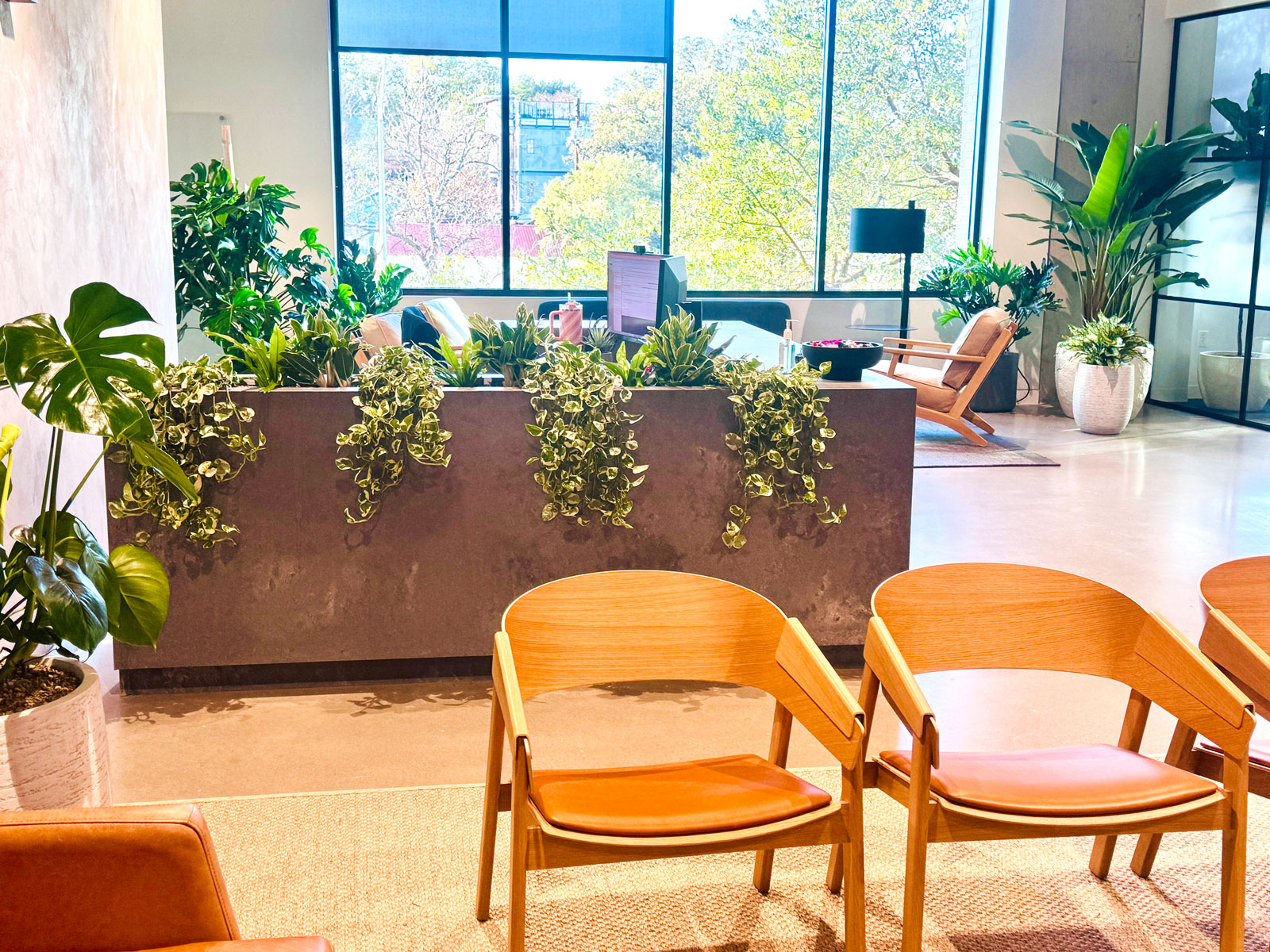
Long troughs or built-in planters along partitions or railings create consistent acoustic “screens.”
Plants That Support Noise Reduction
-
Large Floor Plants and Shrubs
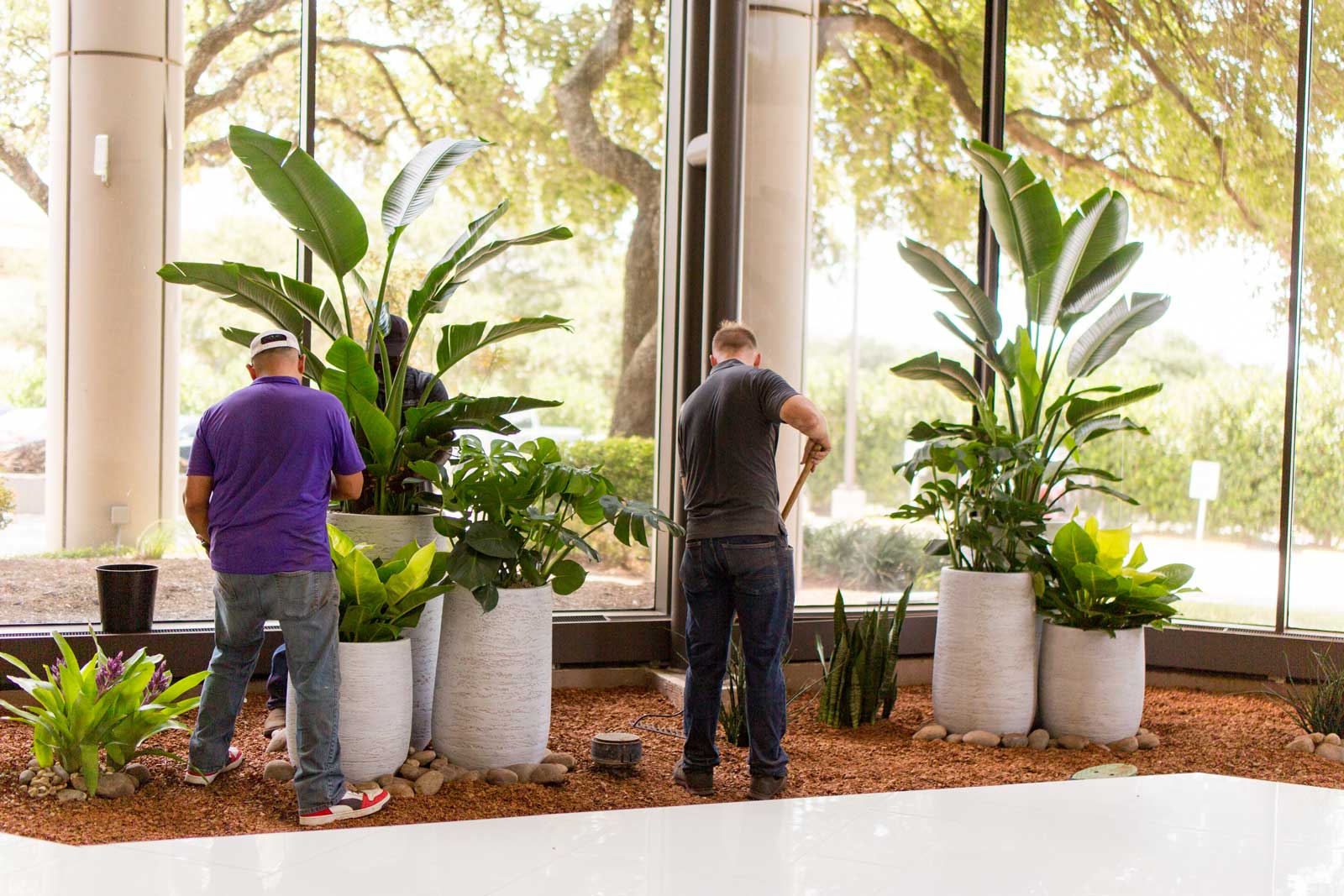
Ideal for acting as soft “barriers” near circulation routes or between collaboration and focus zones.
-
Planter-Top Arrangements on Cabinets or Storage Units
Add height and greenery while blocking sight and sound between zones.
-
Green Walls and Vertical Planting Systems
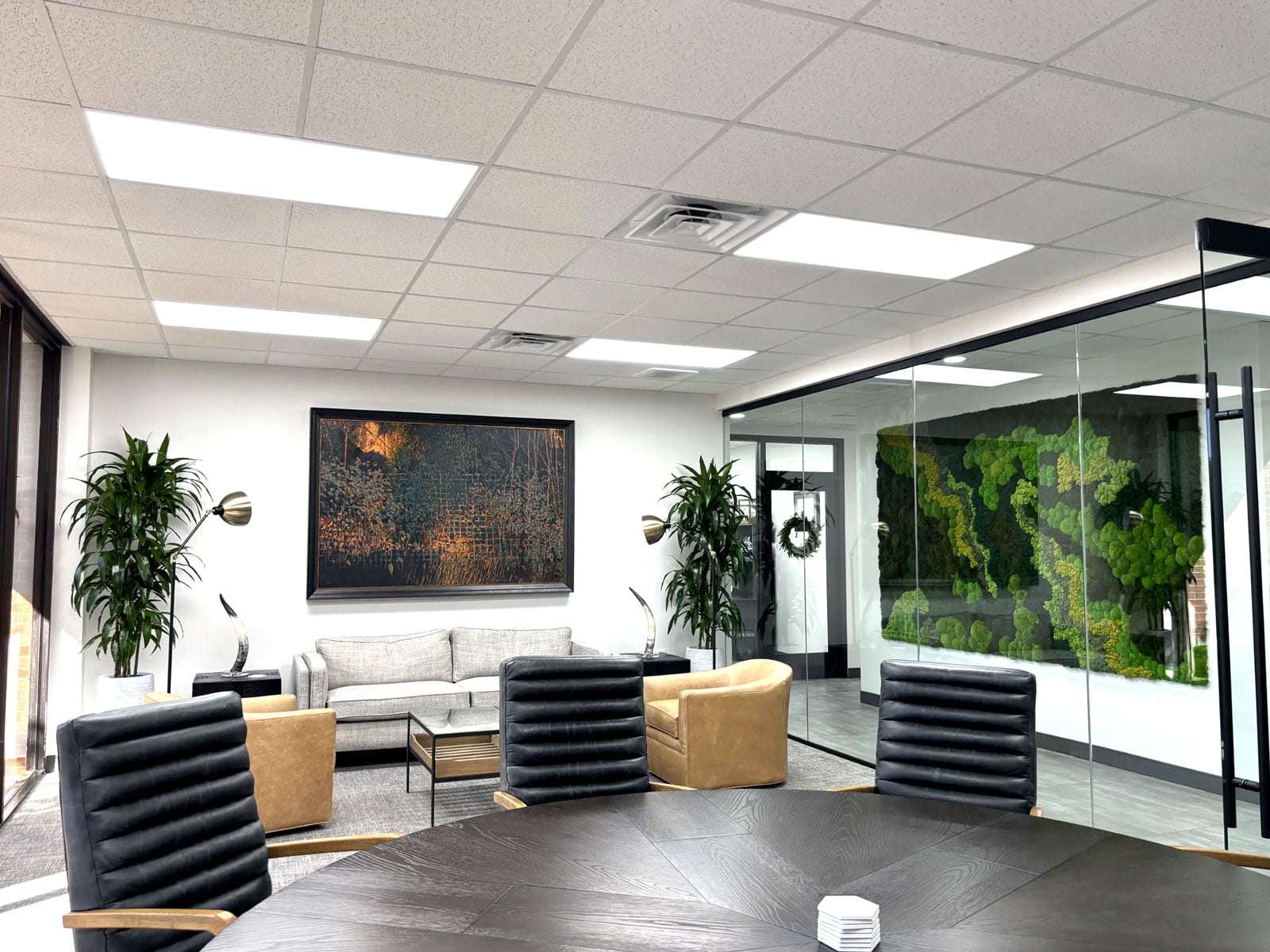
Offer high foliage density per square foot and contribute to sound diffusion on vertical surfaces.
Design Strategies for Plants in Open-Plan Offices
Placement is as important as plant selection when targeting noise reduction.
Recommended strategies include:
Use Plants as Soft Partitions
Deploy tall, dense plants in linear planters between workstations and circulation paths to intercept conversational noise.
-
Buffer High-Noise Areas
Place plant clusters near cafeterias, collaboration hubs, phone booths, and printer stations to soften sound spillover.
-
Treat Reflective Surfaces
Position plants near glass walls, hard corners, and long corridors where sound tends to reflect and build.
- Combine Vertical and Horizontal Greenery
Use floor plants, planter-topped storage, and green walls together to influence sound paths at multiple heights.
- Maintain Visual Continuity
Ensure plant placement complements workplace design, so acoustic benefits do not come at the expense of layout clarity or movement.
-
Consider Safety and Access
Planting layouts should not interfere with egress routes or obstruct facility maintenance paths.
Integrating Plants with Other Acoustic Solutions
Plants should be viewed as an element of a comprehensive sound strategy, not a standalone solution.
They are most effective when integrated alongside:
-
Acoustic Ceiling Systems
Tiles and baffles handle the bulk of reverberation control.
-
Wall-Mounted Acoustic Panels
Target larger reflective surfaces in meeting rooms and open areas.
-
Soft Furnishings
Carpet, upholstered seating, and curtains all support absorption.
-
Space Planning
Locating quiet zones away from primary traffic routes reduces baseline noise issues.
Plants then add:
-
Visual softness,
-
Micro-level sound diffusion, and
-
Psychological comfort.
When to Involve a Professional Interior Plant Provider
A professional interior plant provider can help facilities and workplace teams:
-
Assess existing acoustic problem areas from a spatial perspective
-
Recommend plant sizes, forms, and densities suitable for noise-supportive placement
-
Design planting layouts that complement existing acoustic treatments
-
Provide containers and systems compatible with building operations
-
Maintain plants so they remain healthy, full, and effective over time
When integrated into a broader workplace strategy, plants become a practical, multi-functional tool improving not just noise conditions, but also aesthetics, employee experience, and overall environmental quality in open-plan offices.

Established in 1983, Natura - Interior Plant Design transforms workplaces with biophilic design. We specialize in interior plant design, indoor plant service, and corporate plant service, focusing on interior plantscaping and green walls to enhance office environments, boost wellness, and increase productivity. Serving major markets across Texas and Florida, we deliver live plants, green wall systems, and holiday decor packages to create thriving environments where people live, work, learn, and play. At Natura, we care for both plants and people within the built environment, reconnecting people with nature through innovative plant solutions.
Serving businesses across:
Dallas, Houston, Austin, San Antonio, Corpus Christi, Tampa, Orlando, and Sarasota.