.png?width=14&height=14&name=Group%20(3).png)
.png?width=14&height=14&name=Group%20(4).png)




 By
By
Air quality has become a central concern for large commercial buildings, particularly as organizations focus on employee health, comfort, and long-term workplace performance. While HVAC systems, filtration, and ventilation strategies do most of the heavy lifting, indoor plants can play a supportive role in improving perceived and micro-scale air quality across offices, lobbies, and shared spaces.
For facilities managers and workplace strategists, the practical question is not just whether plants can help air quality, but **which plants are most suitable for large commercial buildings** and how they should be deployed. This guide offers a corporate-focused breakdown of air-purifying plants, their mechanisms, and best practices for integration at scale
-
How Plants Support Indoor Air Quality in Commercial Buildings
-
Key Characteristics of Air-Purifying Plants for Corporate Use
-
Recommended Plant Categories That Improve Indoor Air Quality
-
Example Plant Species Commonly Used in Large Commercial Interiors
-
How to Deploy Air-Improving Plants Effectively in Large Buildings
How Plants Support Indoor Air Quality in Commercial Buildings
Plants interact with indoor air primarily in three ways:
-
Gas Exchange
Through photosynthesis and respiration, plants absorb carbon dioxide and release oxygen, supporting fresher air in microzones.
-
Particulate Interaction
Plant leaves and surrounding soil can help trap dust and fine particulates, which are later removed during cleaning or maintenance.
-
Humidity Stabilization
Transpiration from leaves slightly increases humidity, which can reduce dryness-related irritation and support more comfortable breathing conditions.
Plants function as a complementary layer in a broader indoor environmental quality strategy.
Key Characteristics of Air-Purifying Plants for Corporate Use
Not all plants are equal in their ability to support better indoor air conditions—especially in large commercial environments with complex layouts and strict operational requirements.
Ideal plants for air quality improvement in corporate settings typically have:
-
Broad Leaf Surface Area
Larger leaves provide more surface for gas exchange and particulate interaction.
-
Dense Foliage Structure
Plants with full, bushy growth create more coverage in a smaller footprint.
-
Stable Growth in Low to Medium Light
Most commercial interiors rely on artificial lighting or indirect daylight.
-
Moderate Transpiration Rates
Plants that transpire steadily help stabilize humidity without oversaturating microzones.
-
Low Allergen and Fragrance Potential
Species should be selected to minimize scent, pollen, or irritant output in shared spaces.
-
Robustness in Controlled Environments
Plants need to perform well under air conditioning, variable humidity, and occasional airflow fluctuations.
Recommended Plants That Improve Indoor Air Quality
In large commercial buildings, plant programs should be designed around categories of plants rather than individual species alone.
Key categories include:
-
Large Floor Plants
These provide substantial foliage area and are ideal for lobbies, atriums, and circulation nodes. They help define space while contributing to perceived air freshness.
-
Medium-Sized Clustered Plants
Groups of mid-size plants can be deployed in open-plan offices, collaboration areas, and break rooms to create concentrated zones of greenery.
-
Tabletop and Desk-Level Plants
Individual workstation plants provide localized biophilic benefits and micro-scale air interaction near employees.
-
Green Walls and Vertical Systems
Living walls offer significant leaf area per square foot and can play a role in perceived air quality improvement, particularly in high-traffic zones.
-
Planter-Integrated Partitions
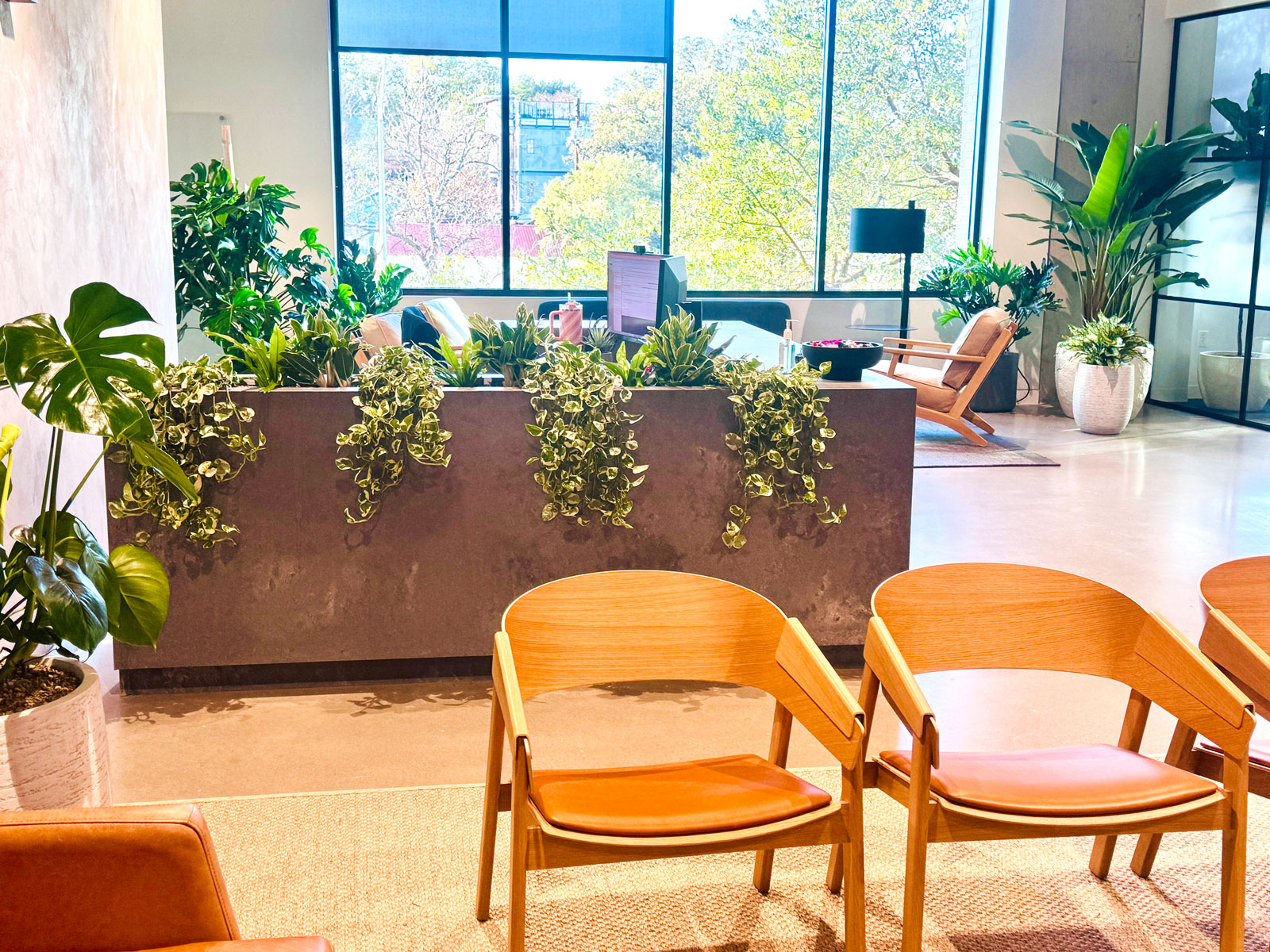
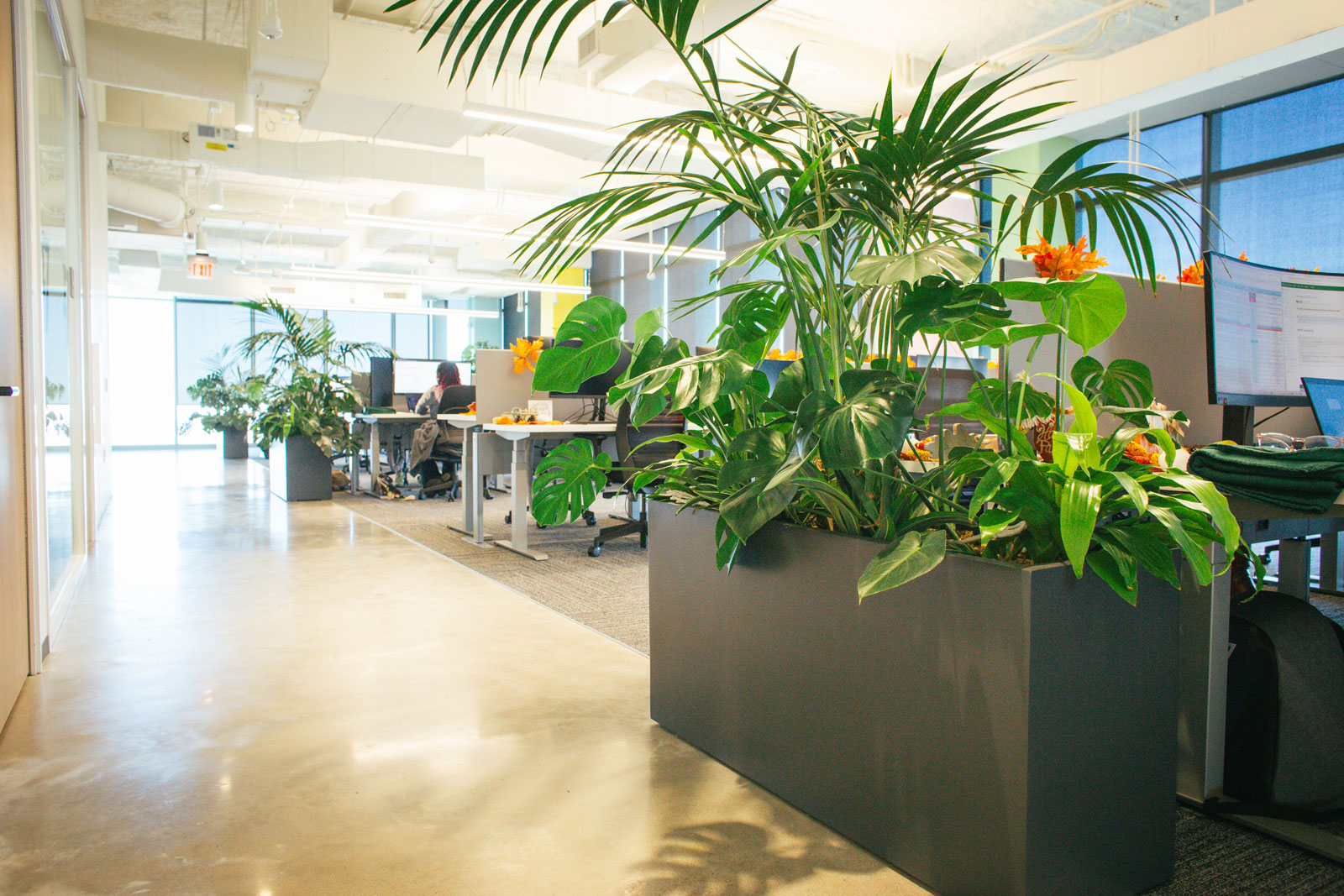
Built-in planters along partitions, railings, or furniture elements add continuous greenery across circulation paths and shared spaces.
Using a mix of these across the building yields more consistent coverage and impact.
Example Plant Species Commonly Used in Large Commercial Interiors
The following species (and genera) are commonly used in corporate environments because of their resilience, foliage density, and suitability for large buildings. These are examples rather than an exhaustive list; selection should always consider local climate, light levels, and maintenance capacity.
-
Aglaonema (Chinese Evergreen)
Broad leaves, good performance in low light, and strong tolerance for commercial conditions.
-
Dracaena Varieties
Upright form, diverse foliage options, and suitability for both floor planters and container groupings.
-
Sansevieria (Snake Plant)
Highly tolerant of low light and inconsistent watering; effective in tight spaces and corridors.
-
Philodendron (including climbing and self-heading forms)
Large leaves and strong biophilic impact; suitable for planters, dividers, and feature arrangements.
-
Monstera Deliciosa and Related Species
Large, fenestrated leaves create strong visual and biophilic presence in lobbies and collaborative spaces.
-
Ficus Species (when conditions allow)
Can be effective in higher-light areas, especially as larger format trees.
-
Zamioculcas zamiifolia (ZZ Plant)
Durable and tolerant of lower light; ideal for secondary spaces and offices.
-
Palms (e.g., Kentia, Rhapis)
Where light is sufficient, palms provide vertical softness and substantial leaf area.
-
Ferns (in appropriate microclimates)
Support humidity and visual softness, particularly in break rooms or lounges.
Species selection should be paired with the building’s mechanical systems, cleaning protocols, and aesthetic direction.
How to Deploy Air-Improving Plants Effectively in Large Buildings
For large commercial properties, success is less about individual plant choices and more about **strategic deployment**.
Recommended strategies include:
-
Zone-Based Planting Plans
Design plant layouts that support key zones: reception, open-plan areas, collaboration points, corridors, and amenity spaces.
-
Density Planning
Higher plant density in areas with frequent occupation (e.g., open work areas, meeting zones) increases perceived air quality benefits.
-
Vertical and Horizontal Distribution
Combine floor plants, tabletop plants, and vertical green elements to maximize foliage coverage without obstructing movement or fire egress.
-
Integration with Existing Systems
Ensure plant placement respects HVAC diffusers, return vents, and sensors, and does not interfere with airflow balancing.
-
Maintenance Access Routing
Design layouts that allow plant technicians to service installations without disrupting daily operations.
-
Multi-Floor Consistency
Standardized plant palettes and density guidelines ensure that air quality benefits are experienced across all key floors and departments.
When to Involve a Professional Interior Plant Provider
A professional interior plant provider can help:
-
Assess current building conditions (light, airflow, humidity)
-
Recommend suitable air-improving plant species and container systems
-
Develop zone-based planting plans for large commercial interiors
-
Coordinate with facilities and design teams during implementation
-
Provide ongoing maintenance to keep plants healthy and effective over time
In large commercial buildings, a structured, professionally managed plant program is the most reliable way to leverage plants as part of a broader indoor air quality and workplace wellness strategy.

Established in 1983, Natura - Interior Plant Design transforms workplaces with biophilic design. We specialize in interior plant design, indoor plant service, and corporate plant service, focusing on interior plantscaping and green walls to enhance office environments, boost wellness, and increase productivity. Serving major markets across Texas and Florida, we deliver live plants, green wall systems, and holiday decor packages to create thriving environments where people live, work, learn, and play. At Natura, we care for both plants and people within the built environment, reconnecting people with nature through innovative plant solutions.
Serving businesses across:
Dallas, Houston, Austin, San Antonio, Corpus Christi, Tampa, Orlando, and Sarasota.
.jpg)